How Does an Avalanche Survey Truck Work?
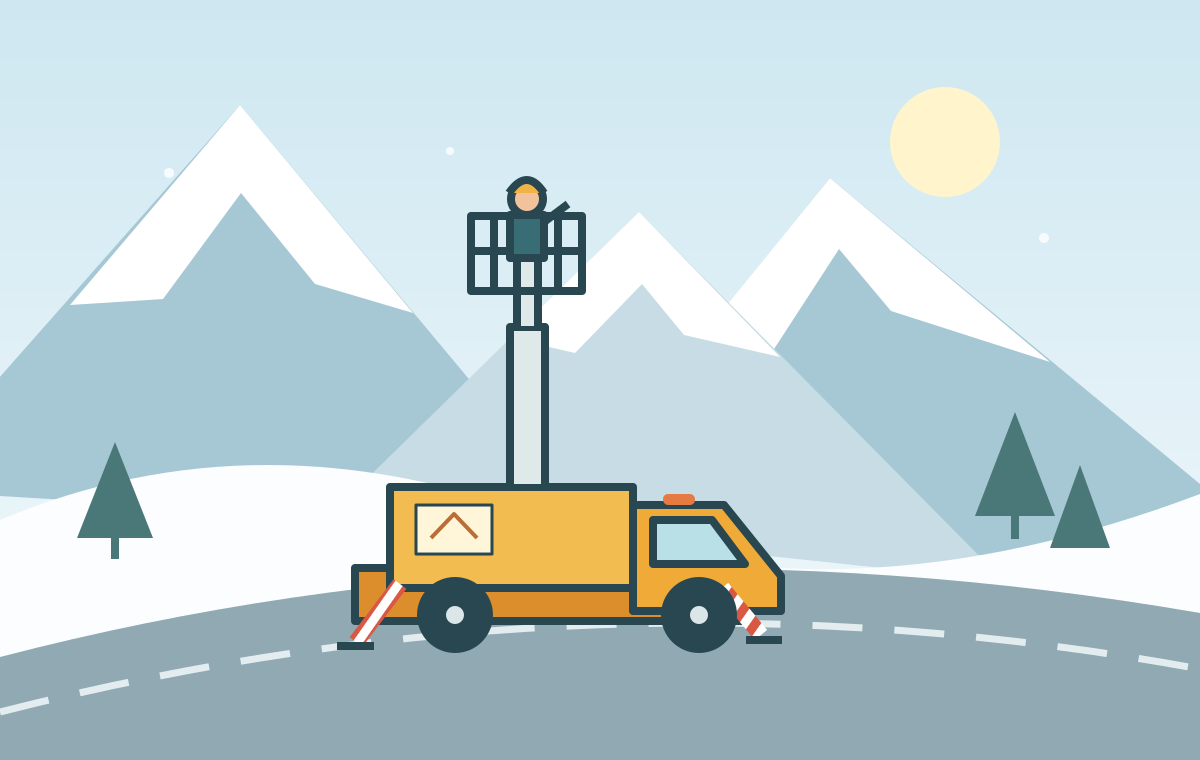
Carmy asksHow does the avalanche survey truck in the picture work?
The Short Answer
It’s a lookout tower on wheels that lifts a worker up to look for clues that snow might slide down the mountain.
An avalanche is a big rush of snow sliding down a slope. The worker isn’t waiting to watch one happen. They want to spot trouble before the snow reaches the road.
Think of It Like This
Imagine stacking crackers on a tilted plate. The top crackers might look fine. But if the layer underneath gives way, the crackers above it could slide off together.
Snow on a mountain can build up in layers, too. A loose layer can be hiding underneath a smooth white top.
So the worker is a snow detective. One clue isn’t enough. They gather several clues and put them together. The tall platform helps them get a better view.
How It Works
-
Give the truck steady feet. The team chooses a place to work after checking the risks. Then the truck puts out outriggers—legs that stick out to help keep it from tipping over. Think of spreading your feet wide so you don’t wobble. Flashing lights and arrow signs warn other drivers to go around.
-
Lift the lookout. A telescoping mast is a tall post that can slide out to become longer, then slide back in. It lifts a platform with rails around it. Now the worker can see over roadside barriers and high walls of snow.
-
Look for clues. Are there fresh cracks? Has snow already slid nearby, leaving tracks and a heap below? Is a big lip of snow hanging over the top of the mountain? That overhanging lip is a snow cornice. It can break off. The worker also watches for signs that the snow has moved or changed shape. These clues can mean trouble.
-
Add the clues they can’t see from the truck. Has lots of new snow fallen? Has the wind piled snow onto one side of the mountain? Has the weather suddenly warmed up? Experts use weather records and snow measurements as well. Sometimes they check the snow’s layers at a site chosen after assessing the risks. A hidden weak layer—a layer that can collapse—might not show up as a crack on top.
-
Tell the road team. If the clues point to danger, the worker reports it. The road may need to close while trained teams decide what to do. The clues don’t say, “An avalanche will start in ten seconds!” They help the team decide when the risk is too high.
Why It’s Built This Way
Up high, you can see more. A snow wall beside the road can block the view. Going up is like stepping onto a little platform to see over a crowd.
Wide feet help it stay steady. When the worker and platform go up, the truck needs firm support. The outriggers support the truck. They don’t hold the mountain’s snow in place.
Wheels carry the lookout to where it’s needed. A truck like this may also have a camera or a light to help record the scene or see in dim light. We can’t tell exactly what every gadget is from this book illustration.
The truck helps people find clues. It cannot warn them about every avalanche. No obvious warning signs does not mean a slope is safe.
Try It Together
Ask a grown-up to help. Put a hardback book in a large tray. Sprinkle a small spoonful of dry oats in a thin layer on the cover.
Slowly lift one end of the book. Make a guess: will the oats slide one at a time, or will a bunch slide together? Lift it a little more and watch. Try two or three times, changing only how much you tilt the book.
Can you spot some oats starting to move while others stay still?
A grown-up can use a little flour instead. Spread it gently. Don’t blow on it or puff it into the air. Don’t eat the materials, and tidy up together afterward.
This shows how loose bits can slide downhill. Real snow has layers and can freeze or melt, so it behaves differently. Your experiment cannot tell you which snowy slopes are safe. Don’t try it on a snowy hillside.
Keep Wondering
- Why might a loose layer underneath fail to hold up the snow above it?
- How can wind pile extra snow on one side of a mountain?
- Where could the team find clues if fog hid the mountain?
- Why might smooth-looking snow still be unsafe?
Notes for Parents
This answer focuses on observation and judgment, not an identified vehicle model. The supplied book photo shows outriggers, a raised platform, a worker, and warning signs. The book describes checking whether snow could slide onto the road. The model, internal lifting mechanism, and exact identity of the side-mounted device cannot be confirmed from this illustration. A camera or spotlight is a possibility, not an identification.
Recent avalanches, cracking, and collapsing snow are warning signs. New snowfall, wind, and warming also matter. Snow depth and buried weak layers require further measurements and expert assessment. Looking from a platform cannot establish that a slope is safe, and a raised platform does not remove avalanche exposure at the work site.
Road closures, clearing snow already on a road, other professional avalanche-control work, and building permanent protective structures are different tasks. They are not a fixed sequence that follows every inspection.
Sources: Colorado Avalanche Information Center: Basic Avalanche Safety and Cornice Fall. The crackers and oats are learning models, not forecasting tools.